The Boiler Upgrade Scheme Explained (UK 2026)
By Rob Hammond · Updated September 2026 · How we score
PowerGuide is reader-supported. We may earn a commission from links on this page. It never affects our rankings or what we recommend. Learn more
The Boiler Upgrade Scheme pays £7,500 towards an air source or ground source heat pump in England and Wales, rising to £9,000 for a property heated by oil or LPG with no mains gas connection until March 2027. You never touch the money: your MCS-certified installer applies to Ofgem and takes the grant off your invoice. The condition most people still repeat, that you need a valid EPC with no outstanding insulation recommendations, is no longer in GOV.UK’s eligibility wording.
Before you go any further, the useful question is not “can I get the grant” but “is my property a sensible candidate”. Our heat pump suitability checker walks through that in a couple of minutes, and it is a better use of an evening than collecting quotes for a house that needs insulation first.
What you can get
GOV.UK sets the grant levels as follows. You can get one grant per property.
| Technology | Grant |
|---|---|
| Air source heat pump (air-to-water) | £7,500 |
| Ground source heat pump, incl. water source and shared ground loops | £7,500 |
| Biomass boiler | £5,000 |
| Air-to-air heat pump | £2,500 |
| Off-gas uplift (oil or LPG, no mains gas), air or ground source | +£1,500, until March 2027 |
The uplift wording is specific, and both halves have to be true: “Until March 2027, you can get an additional £1,500 towards an air source heat pump or ground source heat pump if both: your property is heated by oil or LPG [and] you do not have a mains gas connection at the property.” An oil-heated house with a capped gas main in the street but no connection qualifies; a gas-heated house does not, however rural it is.
The £2,500 air-to-air figure is the newest and least discussed. Air-to-air means a system that heats the air directly rather than heating water for radiators, which in practice is a reversible air conditioning system. It is a smaller grant because it is a smaller job, and it does not give you hot water. Our air-to-air heat pump grant guide covers what the £2,500 buys, the Ofgem condition that the system must meet 100% of the property’s space heating need, and what a split costs to run against gas.
Two limits that catch people out. There is no grant for a hybrid system: GOV.UK says “You cannot get a grant for a hybrid heat pump system (for example a combination of gas boiler and air source heat pump).” And capacity is capped at 45kWth for an individual system, 70kWth where a heat pump is installed alongside one or more others, and 300kWth for shared ground loops: irrelevant for almost every house, relevant for large or shared schemes.
What the grant leaves you paying depends on the job, not on the grant. Nesta’s analysis of four years of scheme data, published 30 April 2026, puts the median air source installation at £13,041 in 2025/26 in real terms, including the unit, installer fees and associated home upgrades, so roughly £5,541 after the £7,500, or about £4,041 off-gas before March 2027. Those subtractions are approximate by construction, because they take a cash grant off an inflation-adjusted median. Our heat pump cost guide works through the spread and the running costs properly.
Who is eligible, and who is not
The current eligibility test is short. GOV.UK: “You’re eligible for a grant if both of the following are true. You must: own the property you’re applying for (including if it’s a business, a second home, or a property you rent out to tenants) [and] be replacing fossil fuel heating systems - such as oil, gas, electric or LPG (liquefied petroleum gas).”
Three things follow from that wording that are worth spelling out.
Landlords and second homes are in. The parenthesis is explicit. What you cannot do is apply as a tenant; the owner applies, through the installer.
Electric heating counts as the fossil fuel system you are replacing. Storage heaters and direct electric are named in the list, which surprises people who assume the scheme is about boilers. The name of the scheme is misleading.
There is no EPC or insulation condition. The EPC-with-no-outstanding-recommendations requirement that ran in the scheme’s early years is gone, and the page now says the reverse about prior help: “You’re still eligible if you’ve already had funding to make your property more energy efficient, for example by insulating it.” If an installer or a comparison site tells you that you need to clear loft and cavity wall recommendations first, that is out of date as of 21 September 2026. Insulating first is still good engineering, because it shrinks the heat pump you need and lifts its seasonal performance, but it is not a condition of the grant.
You cannot get a grant for:
- Most new build properties. Ones the developer is still building are out. If you move into a finished new build with a fossil fuel boiler, GOV.UK says you may be able to apply.
- Social housing.
- A property that has already had government funding or support for a heat pump or biomass boiler. This is the clause that governs stacking, and it is covered below.
- Replacing a low carbon heating system. Swapping an old heat pump for a new one is not funded. The scheme buys fuel switching, not upgrades.
Biomass is tightly fenced: the property must be off the gas grid, in a rural location, and the boiler must have “an emissions certificate showing that polluting emissions are kept to a minimum”. Self-builds cannot get a biomass grant at all, though a self build is eligible for a heat pump grant if you or the original owner built it and “it’s never been owned by a business or organisation”.
How the money actually flows
You never apply, and you never receive a payment. From GOV.UK’s how-to-apply page, the sequence is: get quotes from MCS-certified installers, confirm eligibility (your installer tells you), agree a quote, and then “the installer will apply on your behalf on the Ofgem website. The value of the grant will be taken off the amount you pay for installation. This will be shown on your quotation and invoice.”
Ofgem then contacts you to confirm the installer is acting on your behalf, and may phone or visit to check the installation; MCS may run its own checks.
The deadline that matters is the commissioning clock: “Your installer must commission and install the heat pump within 120 days of applying for the grant or it will not be eligible.” Four months is generous for a normal job and tight for one waiting on a cylinder, a rewire or scaffolding. Ask when the installer intends to apply. Applying early to “secure” a voucher against a job that cannot start for five months is how vouchers expire.
Two practical consequences of the installer-led design. First, the grant is only as good as your installer’s MCS certification, so check it before you check the price. Second, because the money is deducted rather than reimbursed, there is no cashflow gap: you are quoted and invoiced net.
What the uptake figures actually show
Ofgem publishes the running totals, and they are the honest measure of the scheme rather than anyone’s press release. The BUS monthly scheme update, covering 23 May 2022 to 31 August 2026 and last updated 9 September 2026, reports:
| Measure | Figure |
|---|---|
| Voucher applications received | 151,136 |
| Vouchers issued | 101,029 |
| Total value of vouchers issued | £721,534,000 |
| Voucher redemption applications received | 93,981 |
| Vouchers redeemed | 93,364 |
| Total value of grants paid | £661,303,000 |
| Remaining budget, Year 5 (1 Apr 2026 – 31 Mar 2027) | £199,563,000 |
A caveat Ofgem attaches to its own table, and which most write-ups drop: the vouchers-issued figure “does not include vouchers that were issued but have since expired or have been revoked/withdrawn”. So dividing 93,364 redeemed by 101,029 issued gives 92%, and that is not a redemption rate, because the denominator has already had the failures taken out of it. The number that does mean something is 101,029 issued against 151,136 applications, 67%, and even that mixes applications still in progress with ones that went nowhere.
Grants paid work out at an average of about £7,083 per redeemed voucher, which tells you how dominated the scheme is by the £7,500 air source award. Nesta finds 98% of supported installations are air source.
Annual spend, from the same Ofgem table: £50,009,000 in Year 1, £88,330,500 in Year 2, £188,770,000 in Year 3 and £232,720,000 in Year 4 (1 April 2025 – 31 March 2026). Set that against the budgets Nesta reports, £180 million for 2024/25, £295 million for 2025/26 and £625 million for 2026/27, and the pattern is a scheme that overspent its Year 3 allocation by about 5% and then used only 79% of a much larger Year 4 one. Nesta’s read is blunt: BUS supported 30,600 air source heat pumps in 2025/26, up from 24,700, a 24% increase, but “this is a slower growth rate than previous years, and is not enough to meet the UK government’s near-term targets”, and with the budget rising to £625 million “BUS will need to more than double the number of grants it provides to keep pace”.
Two things follow for you as an applicant. The money is not running out this year: £199.56 million of Year 5 budget remained at the end of August 2026, though Ofgem notes that figure is dynamic and already accounts for undetermined applications and issued-but-unredeemed vouchers. And the demand-side constraint is not the grant: it is finding a good installer, which is why the spread between three quotes matters more than the headline award.
Scotland and Northern Ireland
Scotland has its own, larger package. BUS does not apply. Home Energy Scotland offers up to £7,500 as a grant plus up to £7,500 as an interest-free loan for an air, ground or water source heat pump, and a rural uplift of £1,500 for rural and island homes, applied to both the heating and the energy efficiency grants, so, in Home Energy Scotland’s own wording, “rural households can claim up to £18,000 in grant funding” across measures. The loan half is the real difference: a Scottish household can cover £15,000 of a £13,000-ish job without a commercial lender.
Northern Ireland has no equivalent. We checked nidirect’s energy saving grants in your area page on 21 September 2026 and it lists NI Energy Advice, the Affordable Warmth Scheme run by the Housing Executive (with a Warm Healthy Homes Fund consulted on to replace it) and the Northern Ireland Sustainable Energy Programme. These are fuel-poverty and efficiency schemes; none is a heat pump capital grant of the BUS kind. GOV.UK’s own BUS page says the same from the other direction: “The Boiler Replacement Scheme in Northern Ireland is now closed.” If you are in Northern Ireland, the honest position is that there is no heat pump grant to apply for, only the VAT relief below, and we are not going to invent one to fill the section.
Stacking: VAT, ECO4, and what you cannot double up on
0% VAT stacks, automatically. HMRC’s VAT Notice 708/6 zero-rates the installation of specified energy-saving materials, heat pumps among them, in residential accommodation “from 1 May 2023 to 31 March 2027”, after which “these will revert to the reduced rate of VAT of 5%”. This is not something you apply for; it is priced into the quote, and it applies in Northern Ireland as well as Great Britain. On a £13,000 job the difference between 0% and 5% is worth a few hundred pounds, which is a real reason to commission before 31 March 2027 if you were going to do it anyway.
ECO4 generally does not stack. The Energy Company Obligation is means-tested: help is for households claiming a qualifying benefit (Universal Credit, Pension Credit, Income Support, income-based JSA or ESA, Child Benefit, Housing Benefit) in private housing rated EPC D–G if you own it, or E–G if you rent privately, plus social housing at E–G. It can fund insulation and heating upgrades outright. But BUS excludes “a property that’s already been given government funding or support for a heat pump or biomass boiler”, so ECO4 funding for the heat pump itself rules out a BUS grant on the same property. ECO4 insulation is a different matter, and GOV.UK is explicit that prior efficiency funding does not disqualify you. The sensible order if you qualify for both: insulation through ECO4, heat pump through BUS.
One more thing that does stack: the grant does nothing to your running costs, and the running costs are where the heat pump case is won or lost. Put your own gas usage into the heat pump running cost calculator before you decide, or read the honest comparison in heat pump vs gas boiler.
When the grant is not a reason to do it
- Your boiler is young and working. £7,500 off is not £7,500 saved if you are scrapping a serviceable appliance. The scheme has been running since May 2022 and its budget is rising, not falling; the grant will very probably still be there when the boiler dies.
- Your house is uninsulated. The grant is not conditional on insulation any more, which means nothing is stopping you from grant-funding a large heat pump that runs badly. Insulate first.
- You are a tenant. You cannot apply; only the owner can.
- You want a hybrid, or you already have a heat pump. Neither is funded.
- You are selling within a couple of years. The capital is not recovered in the running costs on that timescale, and the grant does not transfer to your feelings about the move.
Check the property first with the heat pump suitability checker, compare units on the heat pumps hub, and see what else you might qualify for on the grants page.
All grant levels, eligibility wording and scheme statistics were checked on 21 September 2026. Grant levels and scheme rules change, and Ofgem’s figures are updated monthly, so re-check before committing.
What’s changed (changelog)
- 21 September 2026. First publication. Built on GOV.UK’s current Boiler Upgrade Scheme pages, Ofgem’s monthly scheme update for 23 May 2022 to 31 August 2026 (last updated 9 September 2026), Nesta’s four-year analysis of 30 April 2026, Home Energy Scotland’s grants and loans page, nidirect’s energy saving grants page and HMRC VAT Notice 708/6. Notably, the “valid EPC with no outstanding insulation recommendations” condition that still circulates widely is not in GOV.UK’s current eligibility wording and has been corrected here.
FAQs
How much is the Boiler Upgrade Scheme grant in 2026?
GOV.UK sets it at £7,500 towards an air source heat pump, £7,500 towards a ground source heat pump (including water source and shared ground loops), £5,000 towards a biomass boiler and £2,500 towards an air-to-air heat pump. Until March 2027, properties heated by oil or LPG with no mains gas connection get an extra £1,500 towards an air or ground source heat pump, £9,000 in total. You can get one grant per property.
Do I need a valid EPC with no insulation recommendations to get the grant?
No. That condition was removed and GOV.UK's current eligibility page carries no EPC or insulation requirement at all. It says the opposite about prior funding: "You're still eligible if you've already had funding to make your property more energy efficient, for example by insulating it." Checked 21 September 2026.
Can landlords and second-home owners get the Boiler Upgrade Scheme?
Yes. GOV.UK's eligibility wording is that you must "own the property you're applying for (including if it's a business, a second home, or a property you rent out to tenants)" and be replacing a fossil fuel heating system. Tenants cannot apply themselves; the owner has to.
How many Boiler Upgrade Scheme grants have actually been paid?
Ofgem's monthly scheme update, covering 23 May 2022 to 31 August 2026 and last updated 9 September 2026, reports 151,136 voucher applications received, 101,029 vouchers issued and 93,364 vouchers redeemed, with grants paid worth £661,303,000.
Does the Boiler Upgrade Scheme apply in Scotland or Northern Ireland?
No. It is an England and Wales scheme. Scotland has the Home Energy Scotland grant and loan, up to £7,500 grant plus up to £7,500 interest-free loan for a heat pump, with a £1,500 rural uplift. Northern Ireland has no equivalent heat pump capital grant: nidirect's energy saving grants pages list fuel-poverty and efficiency schemes only.
Sources
- GOV.UK: Boiler Upgrade Scheme: what you can get · checked 21 Sept 2026
- GOV.UK: Boiler Upgrade Scheme: check if you're eligible · checked 21 Sept 2026
- GOV.UK: Boiler Upgrade Scheme: how to apply · checked 21 Sept 2026
- Ofgem: BUS monthly scheme update · checked 21 Sept 2026
- Nesta: Four years of the Boiler Upgrade Scheme in four charts · checked 21 Sept 2026
- Home Energy Scotland: grants and loans · checked 21 Sept 2026
- nidirect: Energy saving grants in your area · checked 21 Sept 2026
- HMRC: VAT Notice 708/6: energy-saving materials and heating equipment · checked 21 Sept 2026
- GOV.UK: Energy Company Obligation (ECO4) · checked 21 Sept 2026
Related products
Octopus Cosy 6
Octopus's own 6kW R290 heat pump, usually fitted by Octopus, and with the £7,500 grant the all-in price often lands close to a new gas boiler.
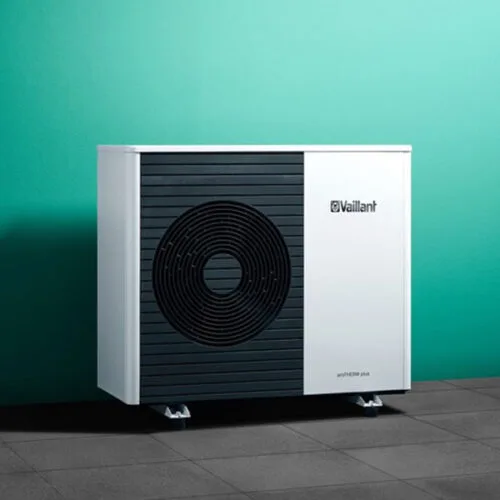
Vaillant aroTHERM Plus
One of the most efficient heat pumps on UK sale: natural R290 refrigerant, 65°C flow temperature and a class-leading SCOP, well suited to retrofits.
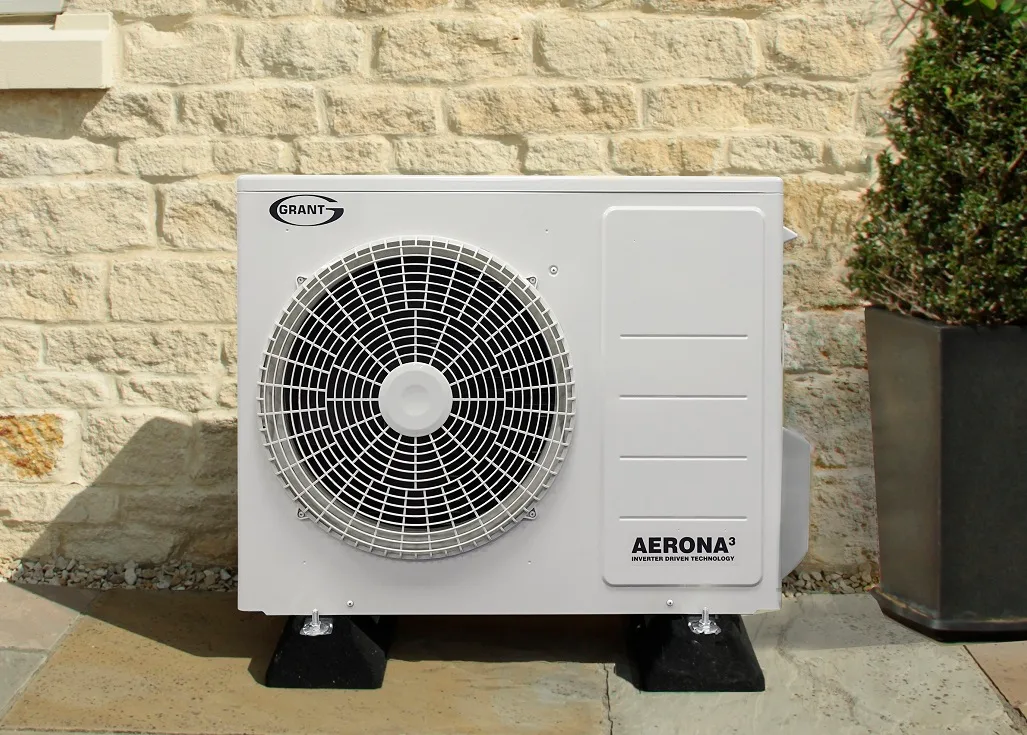
Grant Aerona3
UK-climate-optimised monobloc with a long warranty and a strong reputation among independent installers.
Kensa Shoebox NG
A compact British ground-source unit ideal for flats and terraces on shared ground arrays, with very high, stable efficiency and near-silent indoors.
Related guides
- Ground Source Heat Pump Cost (UK 2026)
Nesta puts the average MCS-certified ground source install at around £21,000. Here is what the £7,500 grant leaves, borehole versus trench, and the measured running costs.
- Heat Pump vs Gas Boiler: Which Is Cheaper in 2026?
An honest comparison of heat pumps and gas boilers on running cost, upfront price, comfort and carbon, and when each one wins.
- How Much Does a Heat Pump Cost in the UK? (2026)
What a UK air source heat pump actually costs in 2026: the median BUS installation price, what the £7,500 grant leaves you paying, and an honest running-cost comparison against gas at the October 2026 price cap.