How Much Does Air Con Cost to Run? (UK 2026)
By Rob Hammond · Updated September 2026 · How we score
PowerGuide is reader-supported. We may earn a commission from links on this page. It never affects our rankings or what we recommend. Learn more
A typical 9,000 BTU portable air conditioner costs about 20p an hour to run in the UK, or £1.58 for an eight-hour evening. A fixed 3.5kW split system doing more cooling averages about 8p an hour across a season, though it pulls about 20.7p an hour while it is actually working flat-out-ish, a distinction we untangle below. Both numbers come from one piece of arithmetic, the unit’s power draw times the electricity price, and the reason people disagree about them is that they disagree about how many hours the compressor actually runs. We have shown that assumption rather than hiding it.
The per-hour number
Every running-cost figure on this page is wattage × hours × price. The price is Ofgem’s cap for 1 October to 31 December 2026: 26.32p/kWh for electricity on direct debit. The wattage comes from the unit. The only judgement call is the duty cycle: the fraction of each hour the compressor is actually drawing power, because a thermostat switches it off once the room is at temperature. Our calculator uses 75% on a normal warm day and 100% in a heatwave, and we state it as an assumption rather than a measurement.
| Unit | Rated draw | At 75% duty | Flat out |
|---|---|---|---|
| MeacoCool MC9000CH (9,000 BTU portable) | 1,005W | 19.8p/h | 26.5p/h |
| Pro Breeze 9,000 BTU 3-in-1 | 780W | 15.4p/h | 20.5p/h |
| De’Longhi Pinguino PAC EX100 (10,000 BTU) | 700W | 13.8p/h | 18.4p/h |
| Pro Breeze 12,000 BTU 4-in-1 | 1,330W | 26.3p/h | 35.0p/h |
| Daikin Perfera (3.5kW split), SEER-averaged | ~405W | 8.0p/h | 10.65p/h |
| The same 3.5kW split at rated input | 1,050W | 20.7p/h | 27.6p/h |
Two notes on where those wattages come from, because they are the whole calculation. The 700W for the De’Longhi is De’Longhi’s own published figure on its GB product page, alongside an EER of 3.6 and a 2.5kW (10,000 BTU) cooling output, and 2.5 ÷ 3.6 = 0.69kW, so the two agree with each other. Our catalogue held 890W and we corrected it to 700W on 21 September 2026 on the strength of that page. For the MeacoCool, Meaco’s own MC Series specification sheet gives the cooling-only 9,000 BTU model as 950 watts for rooms of “16 – 26m²” and has no row for the cool-and-heat 9000CH at all, but Meaco’s product page for the 9000CH does, and it states “Cooling power consumption 1005 watts” (heating 940W). Our catalogue held an unsourced 1,003W and we corrected it to 1,005W on 21 September 2026, which is the figure in the table above. Two watts changes nothing you would notice; publishing a number we cannot point at does.
The split appears twice, and you need both rows. The 405W is not a nameplate figure: it is 3.5kW of cooling divided by the Perfera’s SEER of 8.65, which is a seasonal average that already includes part-load running, thermostat-off and standby time. The 1,050W is the rated input: what the unit actually pulls while working at full output, and the figure behind the “3.5kW split system” preset in the calculator below. So if you pick that preset you will see about 20.7p an hour, not 8p, and neither number is wrong: the first is what a split costs while it is hammering, the second is what it averages over a season of mostly not hammering. Portables are quoted on rated input too, so the 1,050W row is the fair like-for-like against the portables above, and the 405W row is the fair like-for-like against a whole summer.
Per evening, and per summer
The hourly number is the one people ask for and the summer number is the one that matters. Our default is eight hours a day for thirty days, roughly the evenings of one hot British spell. The Met Office defines a heatwave as “a period of at least three consecutive days” at or above a county threshold, so thirty days of genuine air-con weather is a warm summer rather than a normal one; there is no official count of hot days per UK summer we could substitute, so treat the thirty as an assumption you should change.
| Unit | Per evening (8h) | 30-day summer | 60-day summer |
|---|---|---|---|
| MeacoCool MC9000CH (1,005W) | £1.59 | £47.61 | £95.23 |
| Pro Breeze 9,000 BTU (780W) | £1.23 | £36.95 | £73.91 |
| De’Longhi PAC EX100 (700W) | £1.11 | £33.16 | £66.33 |
| Pro Breeze 12,000 BTU (1,330W) | £2.10 | £63.01 | £126.02 |
| Daikin Perfera split, SEER-averaged (~405W) | £0.64 | £19.17 | £38.34 |
The split row uses the SEER-averaged 405W deliberately. Running the 1,050W rated input through the same 75% duty cycle would give £1.66 an evening and £49.74 over thirty days, but that double-counts part-load, because SEER has already allowed for the unit throttling back. Take £19.17 as the season figure and 20.7p/h as the while-it-is-working figure, and do not multiply the second one out across a summer.
What changes on 1 April 2027. Domestic electricity is temporarily VAT-free; when the 5% returns, 26.32p becomes 27.64p. That lifts the MeacoCool’s thirty days from £47.61 to £50.00 and the split’s from £19.17 to £20.13. It is a £2.39 change on the worst unit here: worth knowing, not worth deciding on.
Put your own wattage and hours in, because they matter more than anything else on this page:
Estimate only. We assume the compressor runs 75% of the time as a thermostat cycles it. Real cost depends on the room, target temperature and your tariff.
Portable versus split: why the gap is so wide
Compare like for like, per kW of cooling delivered. The MeacoCool’s 9,000 BTU is 2.64kW, so its 1,005W works out at 381 watts of electricity for each kW of cooling. The Perfera’s 405W against 3.5kW is 116 watts per kW, about 3.3 times less. Two things cause that.
The first is the compressor and heat exchangers. A split has a large outdoor coil in open air and a large indoor coil in the room, and an inverter compressor that modulates rather than cycling on and off. A portable has both coils crammed into one box on your floor.
The second is the hose, and it is the one nobody puts on the box. A single-hose portable blows warm air out of the window, and the air it blows out came from your room. That air has to be replaced, so the room goes very slightly negative in pressure and pulls hot outside air in under the doors and around the frames. You are cooling a room while simultaneously ventilating it with outdoor air. Every portable in our catalogue except the EcoFlow Wave 3 is single-hose.
The regulator treats these as different machines for exactly this reason. Under the retained energy-label regulation (EU 626/2011), standard air conditioners are classed on SEER and SCOP (Annex II, Table 1), while single-duct and double-duct units are classed on EERrated and COPrated (Table 2), a single-condition efficiency, not a seasonal one. The label faces differ to match: Annex III requires a standard air conditioner’s label to carry “annual energy consumption in kWh per year” and its “seasonal energy efficiency ratio (SEER value)”, while a single-duct unit’s label carries “hourly energy consumption in kWh per 60 minutes” and “EERrated” instead. If you have ever wondered why a portable’s “A” looks so much worse than a split’s “A+++”, that is why: they are not the same scale, and they are not even the same units.
The catch is the capital cost. Portables in our catalogue run from £149.99 (the Black+Decker BXAC40025, 9,000 BTU, 1,005W) to £849 (the De’Longhi PAC EX100); split systems are £1,750 to £2,600 supplied and installed. These are indicative catalogue estimates, not sourced prices.
Take the cheapest thing on each side: that £149.99 Black+Decker against a £1,750 Toshiba Seiya (3.3kW, SEER 7.0, so about 471W SEER-averaged and 9.3p an hour). The gap is £1,600.01 and the saving is £25.28 over a thirty-day summer: 63 years. The MeacoCool-to-Perfera pairing is a £2,041.05 gap against a £28.35 saving: 72 years. On a sixty-day summer those become 32 and 36 years. Pick whichever pairing you like: none of them lands inside the life of the equipment.
So: a split never pays for itself on cooling alone. It pays for itself as heating, which is the subject of our air-to-air heat pump grant guide: the same box, run in reverse, against a gas boiler, plus the £2,500 Boiler Upgrade Scheme grant that only applies if it heats the whole property. Buy a split for the winter and the quiet; the summer running cost is a bonus, not a business case.
What SEER actually means, and why the label’s kWh/annum is not your summer
SEER is defined in the retained Ecodesign regulation for air conditioners (EU 206/2012, Annex I) as “the overall energy efficiency ratio of the unit, representative for the whole cooling season, calculated as the Reference annual cooling demand divided by the annual electricity consumption for cooling”. It is a calculated laboratory number built from binned outdoor temperatures, and it already includes thermostat-off, standby and off-mode consumption.
The bit that matters for a British reader is what “cooling season” means in that sum. Annex I defines “equivalent active mode hours for cooling” as “the assumed annual number of hours [h/a] the unit must provide the design load for cooling in order to satisfy the reference annual cooling demand, as set out in Annex II, Table 4”, and Table 4 gives that figure as 350 hours a year for air conditioners other than single- and double-duct units. The reference design conditions in the same annex are 35°C outdoors and 27°C indoors.
So the kWh-per-year figure Annex III puts on a split’s label is 350 hours of a continental cooling season at 35°C. If you run eight hours a night for thirty nights you have done 240 hours, not 350, and rarely at 35°C. Use the label to compare one unit against another, which is what it is for, and use your own hours for the bill.
When the answer is no
- A fan will do. If you need moving air rather than cooler air, a pedestal fan draws tens of watts against a portable’s 690–1,350W and costs a fraction of a penny an hour. Air conditioning earns its keep when the room itself is too hot, not when you are.
- The problem is humidity, not heat. If the complaint is clamminess, damp or condensation, a dehumidifier is the right machine and a much smaller one. Several portables here have a dry mode, and the Russell Hobbs RHPAC12001 removes a claimed 41 litres a day, but running a 1,230W air conditioner to dry a room is using a compressor and a window hose to do a dedicated appliance’s job.
- Running a portable all night, every night. Eight hours at 19.8p is £1.58; do that for ninety nights and it is £142.55 before you have bought the thing. At that level of use the split’s arithmetic starts to look less absurd, and so does insulating, shading or ventilating the room so it does not get that hot in the first place.
- You have not sized the room yet. An oversized unit short-cycles and dehumidifies badly; an undersized one runs flat out at 100% duty and never gets there, which is the expensive failure mode. Work out the BTU first with our what size air con do I need guide and the sizing calculator.
Browse the units themselves on the air conditioning hub, in portable air con or split systems, and run your own numbers in the air con running cost calculator.
All prices, rates and figures were checked on 21 September 2026. The price cap is reset quarterly, so re-check before committing.
What’s changed (changelog)
-
21 September 2026 (revised same day). Corrected the MeacoCool MC9000CH from an unsourced 1,003W to 1,005W, the “Cooling power consumption” figure on Meaco’s own product page for that model, and recomputed every figure derived from it with the same
runningCostfunction the calculator uses: the thirty-day summer moves from £47.52 to £47.61, the eight-hour evening from £1.58 to £1.59, the flat-out hour from 26.4p to 26.5p, the post-VAT thirty days from £49.90 to £50.00 and the efficiency comparison from 380 to 381 watts per kW of cooling. The 19.8p an hour at 75% duty is unchanged. Separately, the MC10000CH, which appears in our sizing guide rather than here, was corrected from 1,114W to Meaco’s spec-sheet 1,085W. -
21 September 2026. First publication. Built on Ofgem’s price cap for 1 October to 31 December 2026, Meaco’s and De’Longhi’s own published specifications, and the retained Ecodesign and energy labelling regulations for air conditioners. Writing it turned up an error in our own catalogue: we held the De’Longhi PAC EX100 at 890W, which contradicted the EER of 3.6 we held for the same unit, and we corrected it to De’Longhi’s published 700W on 21 September 2026. Two things we cannot source: there is no official UK count of “hot days per summer”, so the thirty-day default is our assumption rather than a statistic; and no Meaco specification sheet we can find publishes a power figure for the cool-and-heat MC9000CH, so its 1,003W was our catalogue’s figure against Meaco’s own 950W for the cooling-only 9,000 BTU model. Meaco’s product page for the 9000CH was found later the same day and settled it at 1,005W.
FAQs
How much does it cost to run a portable air conditioner in the UK?
About 20p an hour for a typical 9,000 BTU unit. The MeacoCool MC9000CH draws 1,005W; at the Ofgem cap for 1 October to 31 December 2026 (26.32p/kWh) and a 75% compressor duty cycle that is 19.8p an hour, or £1.59 for an eight-hour evening. Flat out in a heatwave it is 26.5p an hour. A more efficient 780W unit such as the Pro Breeze 9,000 BTU 3-in-1 is 15.4p an hour. Checked 21 September 2026.
Is a split system cheaper to run than a portable?
Yes, by roughly a factor of three per kW of cooling. A Daikin Perfera rated 3.5kW cooling at SEER 8.65 averages about 405W across a cooling season, or 116W for each kW of cooling, against 381W per kW for the 1,005W MeacoCool MC9000CH. That works out at about 8.0p an hour against 19.8p, or £19.17 against £47.61 over thirty eight-hour evenings at the 26.32p cap rate. 405W is the SEER-averaged draw; the split's rated input at full output is about 1,050W, which is 20.7p an hour while it is actually working.
How much does air con cost over a whole summer?
Using the calculator's default of eight hours a day for thirty days at the 26.32p cap rate and a 75% duty cycle: £47.61 for a 1,005W portable, £36.95 for a 780W one, £63.01 for a 1,330W 12,000 BTU unit and £19.17 for a 3.5kW split. Double every figure for a sixty-day hot summer. From 1 April 2027, when VAT returns to domestic electricity, the unit rate becomes 27.64p and the portable's thirty days becomes £50.00.
What does SEER mean on an air conditioner?
Under the retained Ecodesign regulation for air conditioners (EU 206/2012, Annex I), SEER is "the overall energy efficiency ratio of the unit, representative for the whole cooling season, calculated as the Reference annual cooling demand divided by the annual electricity consumption for cooling". The cooling season in that calculation is 350 equivalent active-mode hours a year (Annex II, Table 4), a European average, not a British summer. Portables are not rated on SEER at all: single-duct units are classed on EERrated instead.
Does a portable air conditioner use more electricity than a fan?
Far more. A 1,005W portable at 19.8p an hour is an order of magnitude above a pedestal fan drawing tens of watts. A fan moves air without removing heat, so it only helps while you are sitting in the draught, but if that is all you need, it is the cheapest answer by a wide margin.
Sources
- Ofgem: energy price cap unit rates and standing charges (1 Oct–31 Dec 2026) · checked 21 Sept 2026
- Ofgem: price cap will rise 4% from October 2026 (VAT removal and return) · checked 21 Sept 2026
- Commission Regulation (EU) No 206/2012 (Ecodesign: air conditioners), Annex I: as retained in UK law · checked 21 Sept 2026
- Commission Regulation (EU) No 206/2012, Annex II (reference design conditions, Table 4 operating hours): as retained in UK law · checked 21 Sept 2026
- Commission Delegated Regulation (EU) No 626/2011 (energy labelling: air conditioners), Annex II (efficiency classes): as retained in UK law · checked 21 Sept 2026
- Commission Delegated Regulation (EU) No 626/2011, Annex III (label design and contents): as retained in UK law · checked 21 Sept 2026
- Meaco: MeacoCool MC Series specification sheet (PDF) · checked 21 Sept 2026
- Meaco: MeacoCool MC9000CH product page (technical overview) · checked 21 Sept 2026
- De'Longhi GB: Pinguino PAC EX100 Silent product page (technical specification) · checked 21 Sept 2026
- Met Office: heatwave definition · checked 21 Sept 2026
Related products
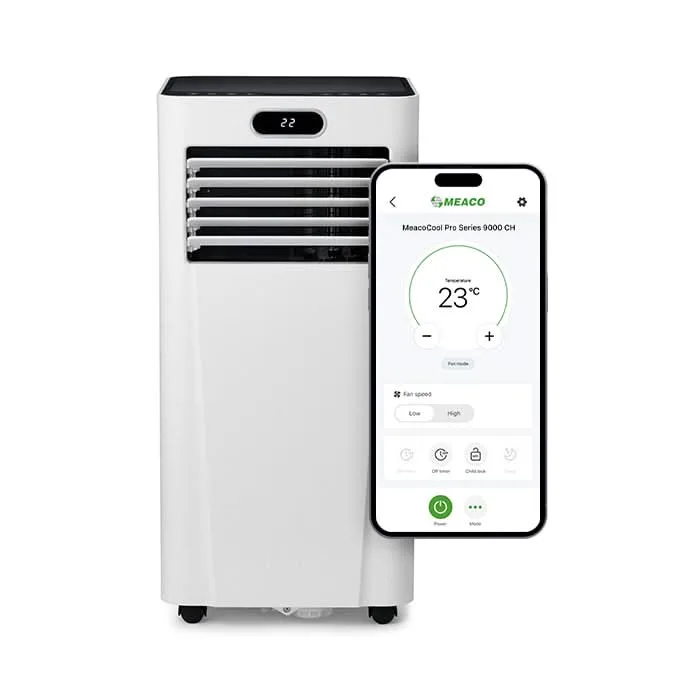
MeacoCool MC9000CH
A 9,000 BTU cool-and-heat portable for medium rooms of 16–26m², with cooling, heating, fan, dry and sleep modes.
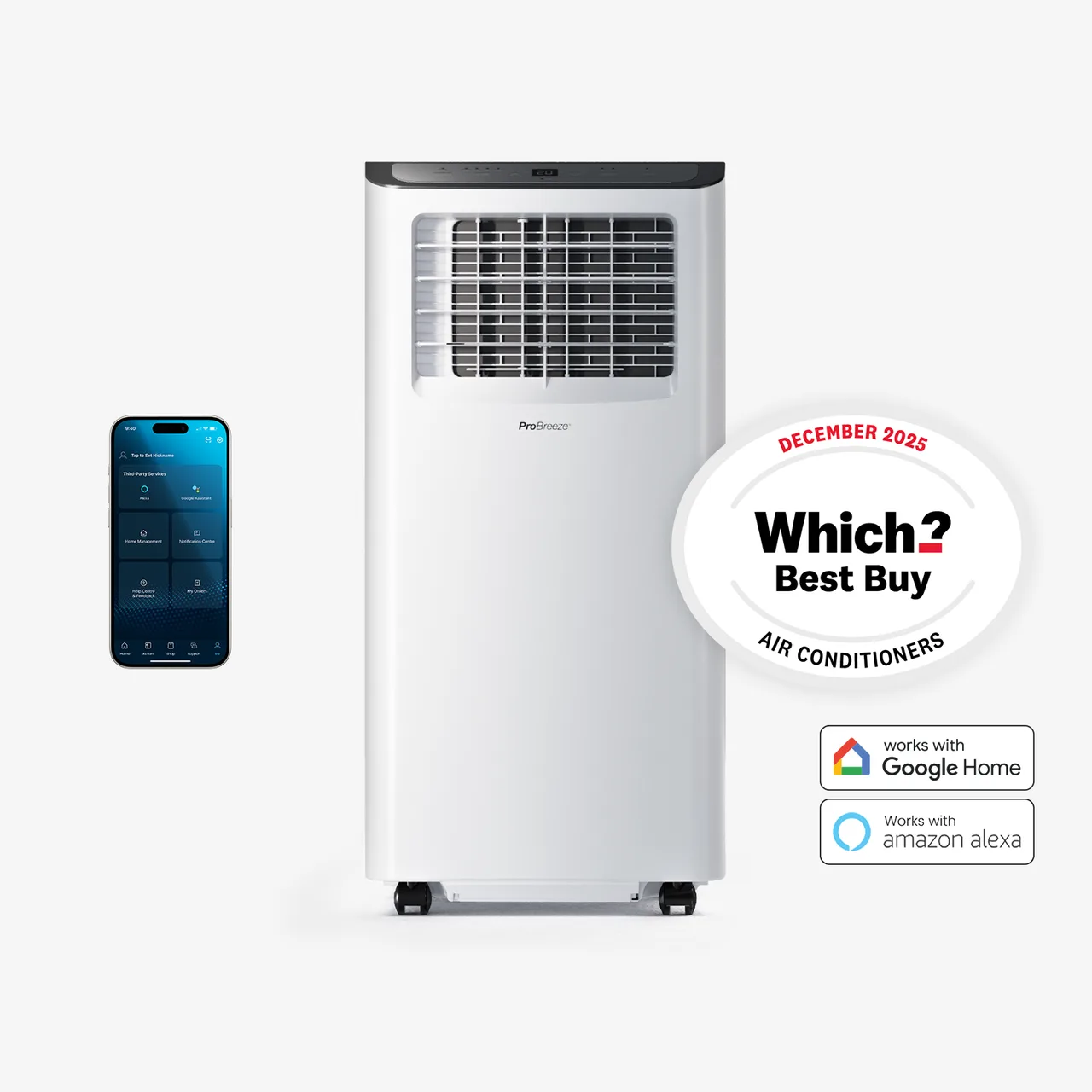
Pro Breeze 9,000 BTU 3-in-1 Smart
A smaller, cooling-only smart AC for bedrooms and home offices up to about 22m² with the same app ecosystem as the flagship.
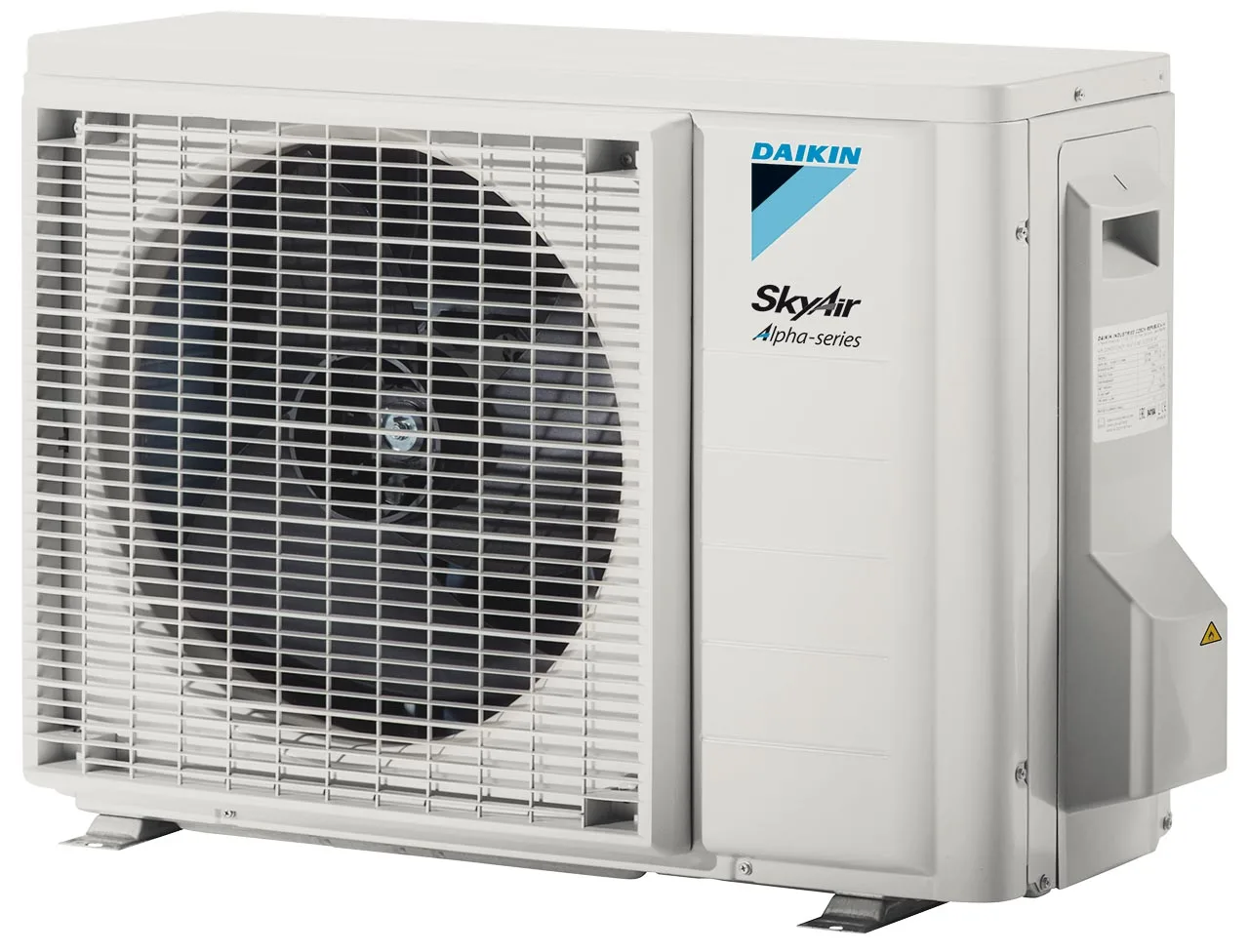
Daikin Perfera
Daikin's flagship wall split, pairing class-leading efficiency with genuinely quiet, refined heating and cooling.
Mitsubishi Electric MSZ-AY
Mitsubishi's mainstream wall unit with built-in Wi-Fi and excellent cooling efficiency.
Related guides
- The £2,500 Air-to-Air Heat Pump Grant: Air Conditioning on the BUS (UK 2026)
GOV.UK pays £2,500 towards an air-to-air heat pump, which is a split air conditioner. The unmentioned condition: it must heat the whole property, not one room.
- What Size Air Con Do I Need? BTU by Room (UK 2026)
A 12m² bedroom needs about 6,000 BTU, a 20m² living room 10,000 and a 30m² open-plan space 15,000. Here is the rule that produces those numbers.