What Size Air Con Do I Need? BTU by Room (UK 2026)
By Rob Hammond · Updated September 2026 · How we score
PowerGuide is reader-supported. We may earn a commission from links on this page. It never affects our rankings or what we recommend. Learn more
A typical 12m² UK bedroom needs about 6,000 BTU, a 20m² living room about 10,000, and a 30m² open-plan space about 15,000, at which point no single portable will do the job properly. Those numbers come from a rule of thumb, not a measurement of your house, and we are going to show you the rule so you can argue with it. Getting this wrong in either direction costs you: too big and the room goes cold and clammy, too small and the unit runs flat out and never gets there.
The BTU number for a room
Our sizing calculator uses a model we wrote ourselves, and it is a rule of thumb rather than a heat-load calculation. 430 BTU per m² of floor area at a 2.4m ceiling, scaled by ceiling height, multiplied by an insulation factor and a solar-gain factor, plus 400 BTU per occupant beyond the first and 800 BTU if the room has heat-producing electronics, rounded up to the nearest 500 BTU because that is the granularity units are sold at.
That is a proxy for a proper heat-load survey, which would count glazing area and orientation, wall and roof U-values, air changes per hour and internal gains individually. There is no official UK domestic sizing standard we can point you at for a single room, and we are not going to dress our rule up as one. What it is good for is getting you into the right band before you spend money.
Three worked rooms, all with average insulation and average sun:
| Room | The arithmetic | Required | ≈ kW | Band |
|---|---|---|---|---|
| 12m² bedroom, 2 people | 12 × 430 = 5,160, +400 | 6,000 BTU | 1.76kW | Small portable |
| 20m² living room, 2 people + TV | 20 × 430 = 8,600, +400, +800 | 10,000 BTU | 2.93kW | Large portable |
| 30m² open plan, 4 people + kitchen | 30 × 430 = 12,900, +1,200, +800 | 15,000 BTU | 4.40kW | Fixed split |
Keep that 20m² living room exactly as it is, two people and a TV, and change only the fabric and the aspect. With poor insulation and a south aspect it comes out at 14,000 BTU, and with good insulation in shade at 8,000 BTU. That is the point worth taking away: the floor area is the smallest part of the answer. The same room, same contents, can need 75% more cooling depending on how it is built and which way it faces, and the 14,000 version has left the portable bands altogether while the 8,000 version has not.
For contrast, here is a manufacturer’s own claim. Meaco’s MC Series specification sheet rates its 8,000 BTU model for “circa 25m²”, the 9,000 BTU for “circa 26m²” and the 10,000 BTU for “circa 28m²”, with a table giving 15–25m², 16–26m² and 18–28m² respectively. At the top of those ranges that is 320 to 357 BTU/m², noticeably more generous than our 430. Both can be true: manufacturers quote the largest room the unit will ever cope with in mild conditions, and we are sizing for the hot day you bought it for. If your room sits between the two answers, believe ours.
Why oversizing is bad, and undersizing worse
An air conditioner does two jobs at once: it drops the air temperature and it condenses moisture out onto the cold coil. The second job takes time. An oversized unit hits the thermostat setpoint fast, shuts down, and leaves the humidity where it was, so the room feels cold and damp rather than cool and dry. Short, frequent compressor starts are also the hardest duty a compressor does, and each cycle wastes the energy already spent getting refrigerant pressures settled.
Undersizing is the more expensive failure on the day it matters. A unit that cannot reach setpoint never cycles off, so it runs at a 100% duty cycle instead of the 75% our running-cost guide assumes, which is a third more electricity per hour for a room that is still too warm. The Met Office defines a heatwave as “a period of at least three consecutive days” at or above a county threshold, so this is a handful of days a year in most of Britain. For the other nine-tenths of the summer, a slightly small unit that runs long and steady dehumidifies better than a slightly large one.
If you are between two sizes, go up if the room is south-facing, poorly glazed or a kitchen, and down if it is a shaded bedroom you only need cool enough to sleep in.
Portable or split, by band
The calculator sorts the answer into three bands:
| Required | Band | What it means |
|---|---|---|
| ≤ 7,000 BTU | Small portable | A compact 7,000–9,000 BTU portable will handle this room. |
| 7,001 – 10,500 BTU | Large portable | You need a larger 9,000–12,000 BTU portable, or consider a fixed split. |
| above 10,500 BTU (≈3.08kW) | Fixed split recommended | A portable is working at the top of its range all day; a split will cope better and cost far less to run. |
The 10,500 threshold is a judgement, not a rule of physics: 12,000 BTU portables are sold and they work. What changes above it is that the portable is no longer cycling comfortably; it is running close to flat out, which means close to its full draw, its full noise figure and its full single-hose penalty. At that duty the split’s roughly three-times-lower draw per kW of cooling stops being an abstraction. The running-cost guide has the arithmetic, and the short version is 8.0p an hour against 19.8p at the 26.32p Ofgem cap rate for 1 October to 31 December 2026.
The five things that move the number
- Ceiling height. The base figure assumes 2.4m; the model scales linearly by height ÷ 2.4. A 20m² living room with a 2.7m Victorian ceiling goes from 10,000 to 11,000 BTU, enough to push it out of the portable band.
- Insulation. ×0.85 for good (modern glazing, insulated walls), ×1.0 average, ×1.25 poor, which is the conservatory, single-glazing and lots-of-glass case.
- Sun. ×0.9 shaded, ×1.0 average, ×1.15 south-facing with heavy afternoon sun. Note that insulation and sun multiply together: poor and south is ×1.4375, which is where that 14,000 BTU living room came from.
- Occupants. +400 BTU for each regular occupant beyond the first. A person at rest is a space heater of roughly 100W, and 400 BTU/h is about 117W.
- Electronics. +800 BTU flat if the room has a large TV, a desktop PC or kitchen appliances running. It is a toggle rather than a sum because you are unlikely to know the wattages.
Which catalogue units cover each band
Prices below are indicative catalogue estimates, not sourced quotes.
Small portable (≤ 7,000 BTU), for the 12m² bedroom. MeacoCool MC7000CH (7,000 BTU, 780W, 54dB, rooms to 22m², around £309, all catalogue figures; Meaco’s MC Series sheet has no 7,000 BTU row, so we cannot put the manufacturer’s name to these) and the EcoFlow Wave 3 (6,100 BTU, 690W, 44dB, around £799), the only dual-hose unit in the catalogue, and the only one that will run off a battery.
Large portable (7,001 – 10,500 BTU), for the 20m² living room. MeacoCool MC9000CH (9,000 BTU, 1,005W, around £359), Pro Breeze 9,000 BTU 3-in-1 (9,000 BTU, 780W, around £330) and MeacoCool MC10000CH (10,000 BTU, 1,085W, around £480). Meaco’s own MC Series sheet gives 1,085W for both its 10,000 BTU models, and our catalogue, which held an unsourced 1,114W, was corrected to 1,085W on 21 September 2026. Meaco’s own product page for the MC10000CH says 1,120 watts on the same date, so the manufacturer disagrees with itself by 35W; we take the dated spec sheet and note the gap rather than splitting the difference. The MC9000CH’s 1,005W now comes from Meaco’s product page for that model, which the spec sheet has no row for.
Fixed split (above 10,500 BTU), for the 30m² open-plan space. Daikin Perfera FTXM35R and Mitsubishi MSZ-AY are both 3.5kW, which is 11,942 BTU; the Toshiba Seiya is 3.3kW (11,260 BTU) and the cheapest way in at around £1,750 installed.
And an honest gap. Every split in our catalogue is a 3.5kW-class single unit, so the largest covers 11,942 BTU, which does not meet the 30m² room’s 15,000. That room needs a 5kW-class split, two indoor heads, or a genuine heat-load survey rather than our rule of thumb, and we do not hold UK prices for any of those. If the calculator puts you above about 12,000 BTU, the next step is an installer with a survey, not a bigger box off a shelf. A split is also a heat pump, which changes the economics entirely. See the air-to-air heat pump grant guide.
When the answer is no
- It is a conservatory. Poor insulation (×1.25) and usually a south aspect (×1.15) push a modest floor area straight into split territory: our 20m² example lands at 14,000 BTU. Under a glass roof in July the real load is worse than any floor-area rule suggests, because the gain is through the glazing rather than the walls. Shading, blinds or a roof film will do more per pound than any unit you can plug in.
- There is no window for the hose. A single-duct portable is not optional about this: the hot air has to leave the building. A sash or casement window takes the supplied kit, but a fixed pane, a skylight you cannot reach or a sealed flat-window system leaves you with nothing to vent into, and running a portable with the hose indoors makes the room hotter. That is a split-system problem, or no problem at all.
- You rent, or you are a leaseholder. A portable is an appliance and nobody’s permission is needed. A split is a hole through an external wall and a condenser unit on the outside of a building you may not own, which for most leaseholders means freeholder consent in writing before anything is fixed to the fabric, the same principle our renters and flats guide and our planning permission guide set out for solar. Planning rules for external units differ from the solar rules in those guides, so check with your local planning authority as well as your freeholder, and do not assume a permitted-development right exists because one exists for panels.
- You have not worked out what it will cost to run. A 15,000 BTU answer is also a bill. Size first, then price it in the running-cost calculator before you buy.
Work your own room through the sizing calculator, then browse the air conditioning hub, portable units or split systems.
All prices, rates and figures were checked on 21 September 2026. The price cap is reset quarterly, so re-check before committing.
What’s changed (changelog)
-
21 September 2026 (revised same day). Corrected the MC10000CH to 1,085W in the catalogue and here, the figure on Meaco’s MC Series specification sheet, and recorded that Meaco’s own product page for the same model says 1,120W. Corrected the MC9000CH to 1,005W from Meaco’s product page for that model (“Cooling power consumption 1005 watts”), replacing an unsourced 1,003W; the running-cost guide’s tables were recomputed with it.
-
21 September 2026. First publication. The BTU figures are computed by the same
requiredBtufunction as our sizing calculator, so the guide and the tool cannot drift apart. Two things we want on the record: the 430 BTU/m² rule and its multipliers are our own model, not a published UK standard, and they are more conservative than manufacturers’ room-size claims (Meaco’s own sheet implies roughly 320–357 BTU/m²). Our split catalogue tops out at 3.5kW (11,942 BTU), so we have no priced answer for the 30m² open-plan example and have said so. Two catalogue figures we could not put a manufacturer’s name to: Meaco’s sheet gives 1,085W for its 10,000 BTU models where we held 1,114W for the CH variant, and it carries no 7,000 BTU row at all, so the MC7000CH’s 780W and 22m² are ours rather than Meaco’s.
FAQs
What size air conditioner do I need for a bedroom?
About 6,000 BTU for a typical 12m² UK double bedroom with average insulation, average sun and two people. That is our own rule of thumb, 430 BTU per m² at a 2.4m ceiling, worked as 12 × 430 = 5,160, plus 400 BTU for the second occupant, rounded up to the nearest 500. A south-facing version of the same room comes out at 6,500 BTU. Both sit in the small-portable band.
How many BTU do I need for a 20m² living room?
About 10,000 BTU with a TV and average conditions: 20 × 430 = 8,600, plus 400 for a second occupant and 800 for electronics, rounded up. Change nothing but the glazing and aspect and the answer moves a long way. The same room, TV and all, with poor insulation and a south aspect needs 14,000 BTU, and with good insulation in shade it needs 8,000.
Is a bigger BTU always better?
No. An oversized unit cools the air to the thermostat setpoint before it has run long enough to condense much moisture out, then shuts off, so it short-cycles, wears the compressor and leaves the room cold and clammy rather than cool and dry. Undersizing is worse on the hottest day, because the unit runs at 100% duty and never reaches setpoint, but it is the better error the other 90% of the time.
When do I need a split system instead of a portable?
Above about 10,500 BTU on our sizing model. Below 7,000 BTU a compact portable is fine; between 7,000 and 10,500 you want a larger portable or a split; above 10,500 a single portable is working at the top of its range all day and a fixed split will cope better and cost about a third as much to run. 12,000 BTU portables do exist, and the band is a recommendation, not a limit.
Do manufacturers' room-size claims match this?
Not closely, and they are more generous. Meaco's own MC Series specification sheet rates its 9,000 BTU unit for rooms of 16–26m², which at the top end implies about 346 BTU/m² against our 430. Take the manufacturer's figure as the largest room the unit can ever handle in easy conditions, and ours as the size it will hold on a hot day.
Sources
- Meaco: MeacoCool MC Series specification sheet (PDF) · checked 21 Sept 2026
- Commission Regulation (EU) No 206/2012, Annex II (reference design conditions): as retained in UK law · checked 21 Sept 2026
- Commission Delegated Regulation (EU) No 626/2011 (energy labelling: air conditioners), Annex II: as retained in UK law · checked 21 Sept 2026
- Met Office: heatwave definition · checked 21 Sept 2026
- Ofgem: energy price cap unit rates and standing charges (1 Oct–31 Dec 2026) · checked 21 Sept 2026
Related products
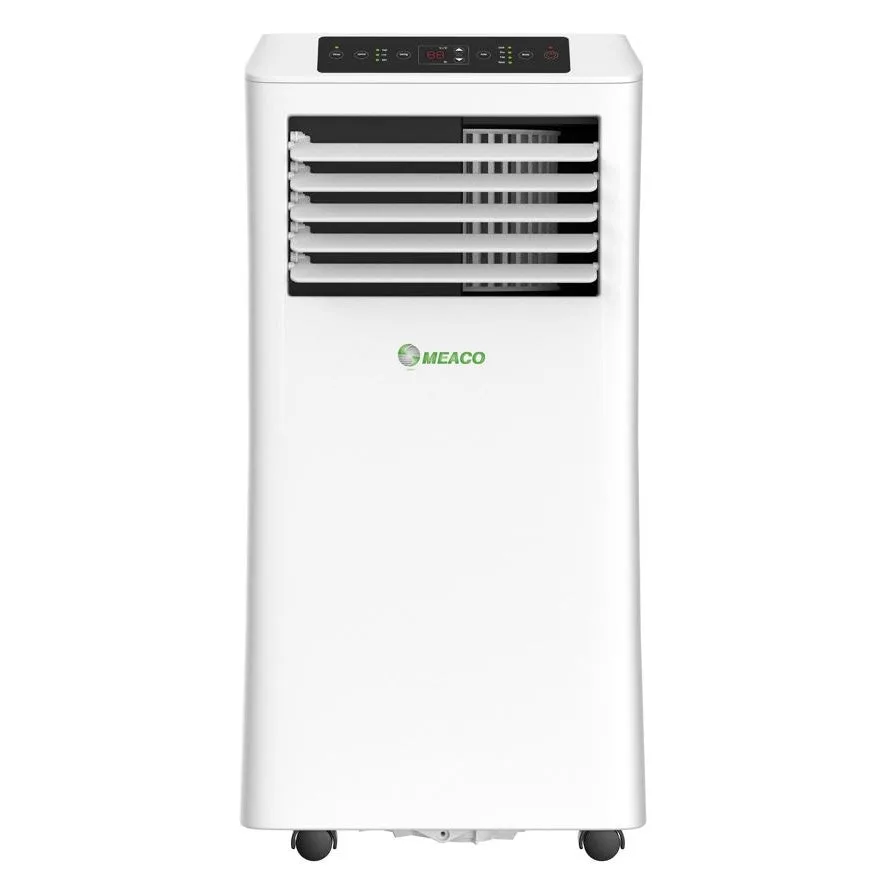
MeacoCool MC7000CH
A compact 7,000 BTU portable with a winter heat mode, aimed at bedrooms and small rooms up to 22m².
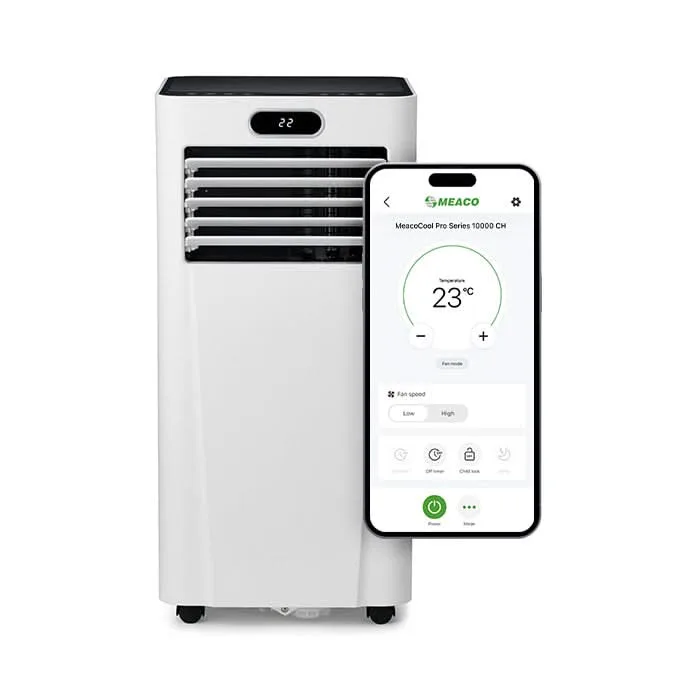
MeacoCool MC10000CH
A powerful 10,000 BTU portable with 9,000 BTU heating, covering rooms up to 28m² and reviewing well for the money.
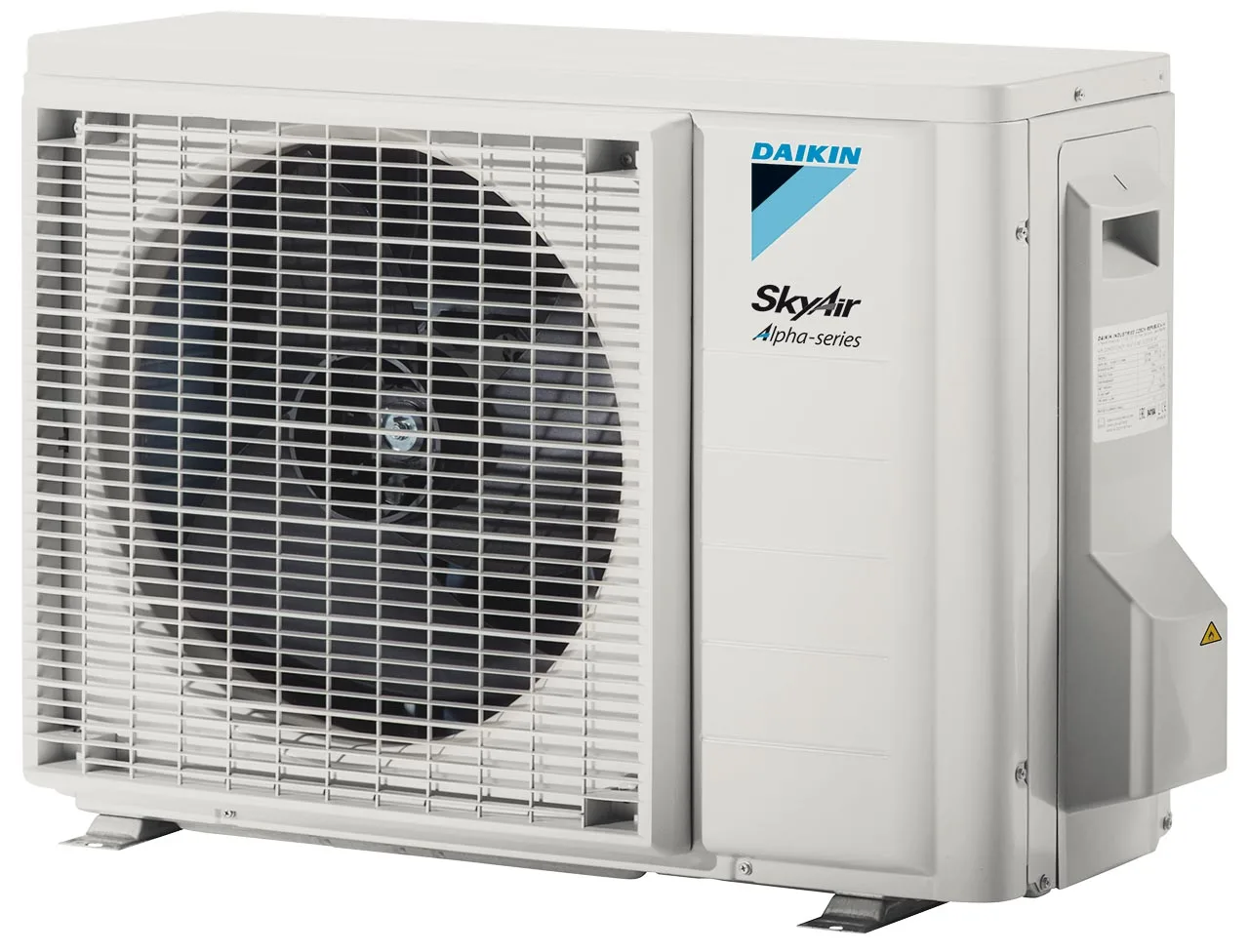
Daikin Perfera
Daikin's flagship wall split, pairing class-leading efficiency with genuinely quiet, refined heating and cooling.
Toshiba Seiya
The value pick: a compact entry-level Toshiba split with a surprisingly good heating SCOP.
Related guides
- The £2,500 Air-to-Air Heat Pump Grant: Air Conditioning on the BUS (UK 2026)
GOV.UK pays £2,500 towards an air-to-air heat pump, which is a split air conditioner. The unmentioned condition: it must heat the whole property, not one room.
- How Much Does Air Con Cost to Run? (UK 2026)
A 9,000 BTU portable costs about 20p an hour at the October 2026 price cap; a 3.5kW split costs about 8p. Worked from wattages and Ofgem's rate.