G98 vs G99: Which DNO Notification Does Your Solar Need? (UK 2026)
By Rob Hammond · Updated September 2026 · How we score
PowerGuide is reader-supported. We may earn a commission from links on this page. It never affects our rankings or what we recommend. Learn more
Every generator you connect to the grid at home has to be declared to your distribution network operator, the company that owns the cables in your street, not your energy supplier. There are three routes, and which one you are on is decided almost entirely by one number: the AC rating of your inverter. Below 800W you may be able to self-register a plug-in kit. Up to 16A per phase you connect first and notify afterwards under G98. Above that you apply under G99 and wait. Getting this wrong is the difference between a ten-minute form and a three-month conversation.
The three routes, in one place
G98 and G99 are Engineering Recommendations published by the Energy Networks Association and adopted through the GB Distribution Code. They are technical documents written for installers, not homeowners, which is why the internet’s summaries of them are so inconsistent. Here is what the current issues actually say.
- Plug-in (up to 800W AC). Since 27 August 2026 a compliant plug-in kit can be self-installed in Great Britain and registered by the householder at myplugin.solar within 28 days. The kit must be listed Compliant on the ENA Type Test Register, output no more than 800W AC from up to 2,000W of panels, have a factory-fitted UK plug and store no energy. The full rules are in are plug-in and balcony solar panels legal in the UK.
- G98 (up to and including 16A per phase). ENA Engineering Recommendation G98 Issue 2, in force from 10 March 2025, covers “Fully Type Tested Micro-generators (up to and including 16 A per phase)”. It is a connect-and-notify process: the installer commissions the system, then sends the DNO a Form B Installation Document.
- G99 (above 16A per phase). G98 Issue 2 is blunt about the boundary: “For Micro-generators greater than 16 A per phase the procedures described in EREC G99 apply.” G99 is an application. EREC G99 Issue 2 states that “Connection of the Power Generating Module is only allowed after the application for connection has been approved by the DNO and any DNO works facilitating the connection have been completed.”
A note on sourcing: the ENA’s own website blocks automated access, so we read the identical published documents mirrored by the GB Distribution Code administrator at dcode.org.uk. Both are Issue 2, dated 10 March 2025, and both are linked in the sources at the foot of this guide.
Where 16A becomes 3.68kW: the arithmetic
The limit is stated in amps, but every installer quotes it in kilowatts, and G98 does the conversion for you. Issue 2 says:
For the purposes of this EREC G98 the Registered Capacity of 16 A per phase, single or multi-phase, 230/400 V AC corresponds to 3.68 kilowatts (kW) on a single-phase supply and 11.04 kW on a three-phase supply. The kW rating shall be based on the nominal voltage (ie 230 V) as defined in BS EN 50160 and the ESQCR.
The sum, so you can check it:
- Single phase: 16A × 230V = 3,680W = 3.68kW.
- Three phase: 3 × 16A × 230V = 11,040W = 11.04kW.
Two things trip people up here. First, it is the inverter’s registered capacity, not the panel array, that counts: a 5kWp roof behind a 3.68kW inverter is a G98 job. Second, it is the aggregate across everything at the property. G98 Issue 2: “where a Customer’s Installation comprises a single Connection Point and more than one Inverter, which have an aggregate Registered Capacity of less than or equal to 16 A per phase … the installation shall be considered as a single Micro-generating Plant.”
The 28-day rule comes from electricity safety law rather than from the ENA. G98 Issue 2 explains that under the Electricity Safety, Quality and Continuity Regulations and the HSE’s 2008 certificate of exemption, “the Installer is required to ensure that the DNO is made aware of the Micro-generator installation before the time of commissioning or no later than 28 days (inclusive of the day of commissioning) after commissioning.”
Which one do I need?
Read the row that matches the total AC inverter capacity at your property, including storage.
| Your situation | Route | Timing | Who does it |
|---|---|---|---|
| Plug-in kit, ≤800W AC, no battery, factory-fitted plug | Plug-in registration at myplugin.solar | Within 28 days of plugging in | You |
| Single-phase solar, inverter ≤3.68kW (16A) | G98 | Notify within 28 days after commissioning | Installer |
| Single-phase solar, inverter >3.68kW | G99 | Apply and wait for approval before connecting | Installer |
| Three-phase solar, total ≤11.04kW (16A per phase) | G98 | Notify within 28 days after commissioning | Installer |
| Solar + battery, combined AC rating ≤3.68kW | G98 | Notify within 28 days after commissioning | Installer |
| Solar + battery, individual units over 16A but aggregate registered capacity ≤3.68kW (16A per phase), no export limiter | G99 Small Generation Installation Procedure-1 | Install and commission, then notify | Installer |
| Solar + battery, aggregate >3.68kW but under 32A per phase, with a G100 export limiter holding export to 16A | G99 Small Generation Installation Procedure-2 | DNO assesses first; results within 10 working days | Installer |
| Solar + battery, combined >3.68kW, no export limitation | G99 standard application | Apply before; see timescales below | Installer |
| Ordinary EV charger (no V2G) | Not G98/G99; separate EV/heat-pump demand notification | Connect-and-notify if total demand ≤13.8kW / 60A per phase (ENWL’s threshold); otherwise apply first | Installer |
| Vehicle-to-grid EV charger | Counts as generation towards the 16A limit | As per the G98/G99 row it pushes you into | Installer |
With a battery
This is the row that surprises people. G98 Issue 2’s foreword states that “The definition of Micro-generators within this document includes Electricity Storage devices and hence this document also applies to Electricity Storage devices … when operating in an export mode.” The glossary repeats it: “For the avoidance of doubt this includes Electricity Storage devices.”
So a 3.68kW solar inverter plus a 3.6kW battery inverter is roughly 7.3kW of registered capacity, comfortably over the G98 line, and a G99 job, even though nothing about the roof has changed. The standard workaround is an export limiter type-tested to EREC G100, which holds what the property can push onto the network back to 16A per phase. G99 Issue 2 defines two small-generation procedures around exactly that case:
- SGI-1: every unit is G98/G99 type-tested, each unit’s intrinsic design capacity is no more than 32A, any unit above 16A is limited to 16A, and the total registered capacity is no more than 16A per phase. Here “the Generator can install and commission all the Power Generating Modules and shall submit notification”, so connect and notify, like G98.
- SGI-2: each unit’s intrinsic design capacity is up to 32A per phase, the total aggregate is under 32A per phase, and a G100 export limitation scheme caps export at 16A per phase. Here you must wait: “No Power Generating Modules should be installed or commissioned before this DNO assessment is complete … The DNO will provide the results of the assessment within 10 working days of receiving the application.”
If the DNO decides it needs a deeper look, SGI-2 ends and the job “will then be progressed in line with the DNO’s standard application process”, so the 10 working days is a best case, not a promise. Our home battery sizing guide covers picking the capacity; this is about what the paperwork does once you have.
With an EV charger
An ordinary charger only draws power, so it is demand, not generation, and it does not count towards the 16A G98 threshold. It still has to be notified, through the separate ENA low-carbon technology process. Electricity North West’s single-EV page sets the test as total electrical demand of 13.8kW / 60A per phase or less for connect-and-notify; answer yes to any of the threshold questions and you must “apply to connect” instead. MCS describes the same split for heat pumps: connect-and-notify at a new maximum demand of 60A or under, apply first between 60A and 100A.
A vehicle-to-grid charger flips the classification. G98 Issue 2 counts as electricity storage “any electric vehicle capable of operating in vehicle to grid mode, but not otherwise”. The “but not otherwise” is the bit that lets your normal charger off the generation rules.
Three phase
Three-phase supplies get three times the headroom, 11.04kW rather than 3.68kW, but the limit is still per phase, so a badly balanced install can breach 16A on one phase while sitting well under 11.04kW in total. That is a job for your installer’s design, not a form-filling decision.
What the DNO can actually say
Three answers are possible, and only one of them is “yes, go ahead”.
A quotation timescale, not an instant approval. For a standard low-voltage generation connection, National Grid Electricity Distribution’s guaranteed-standards table gives 45 working days to provide a “Generation LV” quotation, with an £80 payment to the customer if it is missed. That is a regulated backstop for the quote, not a decision date for the whole project, and the clock is on a complete application. We checked NGED’s table on 21 September 2026; other DNOs publish their own versions, and the ENA documents themselves set no single national figure for a domestic G99.
Export limitation. The most common outcome for a house is approval conditional on limiting export. That means a G100-compliant limiter set to whatever the DNO will accept: sometimes 16A, sometimes zero export. It does not stop you generating or storing; it caps what leaves the property, which matters if you are relying on export payments in your payback sums. Check the assumptions in the solar payback calculator against whatever limit you end up with.
Reinforcement works, at your cost. If the local network cannot take the connection, the DNO quotes for reinforcement. There is no published national figure for what domestic G99 reinforcement costs, because it depends entirely on the state of the cable in your street, and we are not going to invent one. The honest answer is that it ranges from nothing to a number large enough to kill the project, and the only way to find out is the application itself. Ask for the quote before you buy hardware.
Your DNO’s own G98 route
Every DNO runs the same two Engineering Recommendations, but each has its own front door. This is the data behind our DNO notification checker, with the date we last verified each route.
| DNO | Areas served | G98 route | Where | Route verified |
|---|---|---|---|---|
| UKPN | London, the South East and the East of England | Online form (Smart Connect portal) | UK Power Networks ↗ | 2026-07-02 |
| SSEN | Central southern England (Hampshire, Berkshire, Oxfordshire, Wiltshire, Dorset) and the north of Scotland | Email a completed G98 Form B | Scottish and Southern Electricity Networks ↗ | 2026-09-21 |
| SPEN | Central and southern Scotland, Merseyside, Cheshire and North Wales | Email or post a completed G98 form | SP Energy Networks ↗ | 2026-07-02 |
| NPg | The North East, Yorkshire and northern Lincolnshire | Online form (or emailed G98 Form B) | Northern Powergrid ↗ | 2026-07-02 |
| NGED | The Midlands, South West England and South Wales | Online form (~10 minutes, instant acknowledgement) | National Grid Electricity Distribution ↗ | 2026-07-02 |
| ENWL | The North West: Cumbria, Lancashire and Greater Manchester | Email a completed G98 Form B | Electricity North West ↗ | 2026-07-02 |
Two of those pages state the threshold in their own words. Electricity North West: “G98 applies to all generation installations up to 16 amps per phase (Single phase systems up to 3.68kW and Three phase systems up to 11.04kW)”, and “Anything larger will fall into a G99 application.” National Grid Electricity Distribution’s micro-generation page says: “You must notify us of the generation installation within 28 days of commissioning.”
Not sure who yours is? Enter your postcode:
We keep a page per network too, for example UK Power Networks and National Grid Electricity Distribution, with the plug-in route and the G98 fallback side by side.
One caveat on the table above. These routes change without announcement. SSEN, for instance, replaced its two separate regional notification addresses with a single microgen@sse.com, which we picked up on 21 September 2026. Always use the address on the DNO’s own live page, not ours, if the two disagree. UK Power Networks’ page blocked our check on the day, so its route is carried forward from the date shown rather than re-confirmed.
Five ways this goes wrong
1. Assuming the installer notified. The duty sits with the installer under G98, but nobody audits it. Ask for the Form B or the portal reference number, and keep it, because Smart Export Guarantee suppliers want evidence that the installation was notified, and it is far easier to produce on the day than to reconstruct a year later.
2. Hardwiring a “plug-in” kit. The 800W self-install route exists only for a kit with a factory-fitted plug, used as designed, in a normal socket. Cut the plug off and wire it into a spur and you have built a hardwired micro-generator that needs a G98 notification by a competent installer, and you have voided the route that made it legal.
3. Calling a 1,000W system “plug-in”. In our reading of the ENA register, listings are per device, not per installation. Two 800W kits on the same property are 1,600W of generation, and nothing on myplugin.solar makes that a plug-in installation. Above 800W you are on the G98 path like everyone else.
4. Forgetting the battery in the sum. Covered above, and it is the single most common reason a “simple G98 install” turns into a G99 application halfway through. If the quote includes storage, ask which route the installer is using and whether a G100 limiter is part of the price.
5. Buying G99-size hardware and expecting a fast yes. A 5kW or 6kW single-phase inverter is over the line before anything else is added. That is an application, with a network assessment behind it and the possibility of an export limit or a reinforcement quote at the end. Size the system first: our how many solar panels do I need guide walks through it, and the inverter listings show the AC ratings. Then choose the route, not the other way round. Our solar inverters explained guide covers why a 3.68kW inverter behind a larger array costs so little generation, which is what makes staying under the line cheap.
If you are still at the “is any of this worth it” stage, start at the solar hub and are solar panels worth it; the notification route only matters once the system size is settled.
All prices, rates and figures were checked on 21 September 2026. Engineering Recommendations are reissued periodically and DNO contact routes change without notice, so re-check the ENA document and your own DNO’s page before relying on either.
What’s changed (changelog)
- 21 September 2026. First published, against EREC G98 Issue 2 and EREC G99 Issue 2 (both 10 March 2025), with the per-DNO routes rendered live from our network operator data.
FAQs
What is the difference between G98 and G99?
G98 is a connect-and-notify route for fully type-tested micro-generators up to and including 16A per phase. ENA Engineering Recommendation G98 Issue 2 (10 March 2025) states that 16A per phase 'corresponds to 3.68 kilowatts (kW) on a single-phase supply and 11.04 kW on a three-phase supply'. You install, then tell the DNO no later than 28 days after commissioning. G99 is the procedure for anything larger: the same document says 'For Micro-generators greater than 16 A per phase the procedures described in EREC G99 apply', and under G99 the DNO has to approve before the kit is connected.
How long does a G99 application take?
It depends which G99 procedure you land in. For the Small Generation Installation Procedure-2 route (multiple inverters behind a G100 export limiter), EREC G99 Issue 2 says the DNO 'will provide the results of the assessment within 10 working days of receiving the application'. For a standard low-voltage generation connection quotation, National Grid Electricity Distribution's guaranteed-standards table gives 45 working days, with an £80 payment if that is missed. Different DNOs publish their own figures; we checked NGED's on 21 September 2026.
Does a battery count towards the 16A G98 limit?
Yes. EREC G98 Issue 2 states that the definition of micro-generators 'includes Electricity Storage devices'. Your battery inverter's registered capacity is added to your solar inverter's, and if the total exceeds 16A per phase you are into G99, which is why so many solar-plus-battery installs use a G100 export limiter to hold the site back to 16A.
Do I have to notify the DNO about an EV charger?
Yes, but through a different process. A normal charger is demand, not generation, so it does not count towards the 16A G98 threshold. Electricity North West's single-EV page sets the connect-and-notify test at total electrical demand of 13.8kW / 60A per phase or less; above that you apply before installing. A vehicle-to-grid charger is different: EREC G98 Issue 2 counts 'any electric vehicle capable of operating in vehicle to grid mode' as electricity storage, so a V2G charger does count towards 16A.
Can I do a G98 notification myself?
For a hardwired system, no: EREC G98 puts the duty on the Installer, and the forms ask for the commissioning tests. The one route a householder can complete themselves is plug-in solar: a compliant kit of up to 800W AC registers free at myplugin.solar within 28 days of being plugged in.
Sources
- ENA: Engineering Recommendation G98 Issue 2 (10 March 2025), mirrored by the GB Distribution Code administrator · checked 21 Sept 2026
- ENA: Engineering Recommendation G99 Issue 2 (10 March 2025), mirrored by the GB Distribution Code administrator · checked 21 Sept 2026
- National Grid Electricity Distribution: Connection guaranteed standards of performance · checked 21 Sept 2026
- National Grid Electricity Distribution: Micro-generation (single premises) G98 · checked 21 Sept 2026
- Electricity North West: Micro-generation and storage connections · checked 21 Sept 2026
- SSEN: Installations up to 3.68kW per phase at a single premises · checked 21 Sept 2026
- Electricity North West: Connecting a single EV charging point · checked 21 Sept 2026
- MCS: Notifying DNOs · checked 21 Sept 2026
- ENA: Type Test Register · checked 15 Sept 2026
- ENA: myplugin.solar registration portal · checked 15 Sept 2026
Related products
Solis S6 Hybrid
Single-phase 5kW hybrid inverter with dual MPPTs and broad battery compatibility.
Growatt SPH 5000
Budget-friendly single-phase hybrid inverter with a 4kW AC output and 9.5kW of PV input, popular on cost-led residential installs.
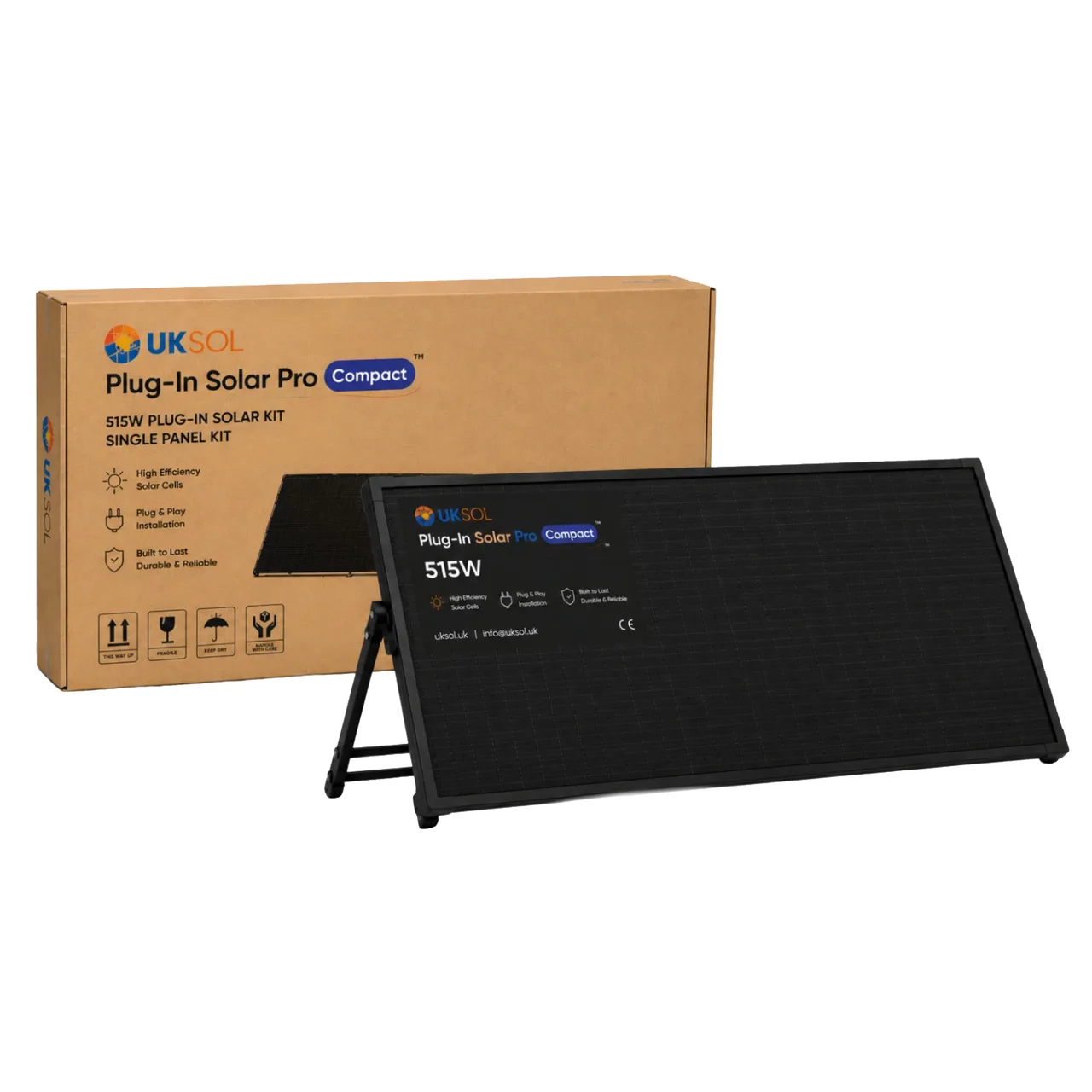
UKSOL Pro Compact 515W Hybrid Mount
A single 515W bifacial panel on UKSOL's adjustable Hybrid mount (for ground, flat roof or wall), run by an APSystems EZ1-M 800W microinverter.
Related guides
- Are Solar Panels Worth It in the UK? (2026)
A worked payback for a £7,238 4.4kWp array at three self-use rates and two export tariffs, 7.8 to 14.9 years, and the five cases where the answer is no.
- How Long Do Solar Panels Last? (UK 2026)
Panel warranties run 15–30 years and the warranted degradation curves put year-25 output at 89.9–91.0%. Here is the arithmetic, from four manufacturers' own datasheets.
- How Many Solar Panels Do I Need? (UK Guide, 2026)
Work out your solar array size from your annual kWh, with real generation figures by region, orientation and pitch, official UK installation costs, and a worked payback at the October 2026 price cap.
- How Much Do Solar Panels Cost? (UK, 2026)
UK solar costs from DESNZ's official 2025/26 data: £1,955/kW under 4kW, £1,645/kW above it, so a typical 4.4kWp array is £7,238, and generates at about 7p/kWh.